Showing posts with label Water. Show all posts

Wednesday, November 18, 2020

Being Black in America in 2020.

In this last unit  Rhetoric "Unite", we talked about how art can be the use of Rhetoric. In this action project, we looked closely at rhetorical art that politicians use to present themselves or get a message across. We learned about many different rhetorical devices, appeals, and that people use to get messages across to an audience. In class, briefly talked about the art inside of rhetoric by looking at past students' action projects so we could prioritize our own artworks followed by an artist statement. My artist statement will go further in-depth about the use of rhetoric inside of my artwork.

The purpose of this action project is to use a medium of art to bring people together while also sending a message through the rhetorical meaning of your artwork. For one of our field experiences, we went to Marquette Park and looked at an art piece and memorial called the "Living Memorial". It's based on Rev. Dr. Martin Luther King Jr. and his work he did to immobilize racial discrimination throughout Chicago in the '60s. I chose to do something that is impossibly unavoidable due to my existence, being black in the United States of America in our current year 2020. I used a fading "Black Lives Matter" sign from a protest for Breonna Taylor, George Floyd, and the remaining existence of systemic oppression and modern-day lynching in America. Here's the link to a quote from former US President Donald Trump I used in my piece.


Rhetorical Art Piece: Being Black in America. N.L. (2020)

Rhetorical Art Piece: Being Black in America. N.L. (2020)

Rhetorical Art Piece: Being Black in America N.L. (2020)

Artist Statement:

I’m a young black male in a country that was built off the backs of my people. A country that continues to not acknowledge the murders, genocides, and over-exploitation of African Americans. The topic of my artwork is a blink of the world I experience in the United States of America. The message behind this piece is that blackness shouldn’t be feared and tolerated. Black and brown-skinned people in this country should be accepted just as those of “fair skin” is. My skin color and whether or not people of color lives matter shouldn’t be a controversial topic at all! My call for justice shouldn’t become another hashtag or trend on social media as a flex of being an ally to the black community. This topic is detrimental to my existence in this country and should evoke controversial discussions and arguments. I chose to reuse a sign from a protest I attended back in June because there’s sentimental value in the poster being repurposed as artwork. I used mostly black sharpie markers and two paint markers to add some detail. I felt that drawing on the sign I kept from an actual protest got my message across way better than customizing the statement behind the movement, “Black Lives Matter” in my sketchbook. I utilized the rhetorical appeals and devices within my work to boldly present my position on the fact that the lives of black people do matter and that facts need to be interpreted within the laws, acts, and amendments in this country. I openly used the rhetorical appeal of pathos in my art by crossing out the word “all” and replacing it with “black” to restate my position and the fact. Words such as “murders”, “violent”, “aggressive”, “suspects”, and “targets” are often misconceptions and stereotypes of black people and were used to represent the rhetoric devices of hyperbole and metaphor. I used parallelism by writing a positive and negative word correlated by the letter of the two words such as “statistics” and “survivors” inside of the letter S itself. Lastly, there was the device of anaphora within the use of quoting Donald Trump’s proposal on why black Americans should’ve voted for him during his campaign. If this sign were ever to be in a history museum, my sign art should be housed in the same section of the countless painted wooden boards that were used for the protection of storefronts across Chicago. “The American Negro finds himself living in a triple ghetto: a ghetto of race, a ghetto of poverty, and a ghetto to deal with this problem, the problem of dealing with these two Americas. We are seeking to make America one nation, indivisible, with liberty and justice for all.” - Rev. Dr. Martin Luther King Jr. The Civil Rights Movement was not that long ago, and here we are in the year 2020 “fighting” the same issues of this country and its people. Living with that fact in my mind as a teenager disgusts me on a level unimaginable. African Americans, blacks and “negroes”, whatever you call us, we still haven’t been given general decency or respect on a humane level. From gestures such as a greeting while walking by. I can’t walk down a busy street in Chicago’s Loop (downtown) without feeling the racial tension between the people I walk past that happen to be predominantly white. Black people in America are feared, often called intimidating, and treated inhumanely, disrespectfully, and even killed to subdue the emotions non-blacks feel. Black Lives Matter is an organization and a statement. Many Americans argue that they support the statement but not the organization because the organization is involved with controversies and politics overall. I interpret that support similar to someone stating, “I support that veterans need to be treated better after serving their country. But I can’t support an organization involved with seeking resources for veterans because of the controversies within politics.” It just doesn’t add up to not support something that stands for the overall well being of a people group just because of different views the organization has on real-world issues. I guarantee if the organization did not represent people of color in this country, the arguments around making the USA safer for black and brown people being controversial would cease to exist due to white silence and privilege. To be clear, you are not an ally if you only say BLM for short instead of what it stands for, if you use the statement and name of the group to prove your not racist or have prejudice, and if you only support the phrase and not the organization.

Monday, October 29, 2018

How does climate change effect Chicago?

This action project is for my STEAM course, on the unit of water. This week we were focusing on the difference between climate and weather. We converted temperatures in Fahrenheit to Celsius and Celsius to Fahrenheit. We went on a Field Experience to the Lincoln Park Conservatory where we measured temperature and humidity in each room. I learned how the conservatory varies the climate in each room by using steam heating and windows on the ceilings as vents. At the end of the week, we were assigned an action project that took one region, country, or city and explained how the weather and climate in that place will change by 2100. Hope you enjoy.


Works Cited:
Benfield, Kaid. “What Communities Should Do To Protect Against Climate Change.” CityLab, 22 Mar. 2012, www.citylab.com/equity/2012/03/what-communities-should-do-protect-against-climate-change/1562/.
“Illinois State Water Survey - the University of Illinois at Urbana-Champaign.” The climate of Chicago - Description, Illinois State Climatologist Office, Illinois State Water Survey, U of I, www.isws.illinois.edu/statecli/General/chicago-climate-narrative.htm.

“WeatherSpark.com.” Average Weather in Chicago, Illinois, United States, Year Round - Weather Spark, weatherspark.com/y/14091/Average-Weather-in-Chicago-Illinois-United-States-Year-Round.

What Is the Carbon Cycle?, www.netl.doe.gov/research/coal/carbon-storage-1/faqs/what-is-the-carbon-cycle.

“350 Climate Science Basics.” 350.Org, 350.org/science/.


Wednesday, October 17, 2018

My Water Filter

This is my second action project for my STEAM course on the unit “Water.” The project is to make water filter that filters dirty water into clean and potable water. During this class, we have been studying water filtration. In class, we learned about logarithms, and we also learned how to find pH levels using logarithms and scientific notation, and what the pH scale is. We went on a field experience to the Jardine Water Treatment Plant. During the field experience, I learned about the filtration process that provides clean water for the city of Chicago. These studies and experiences have all helped me create this action project.
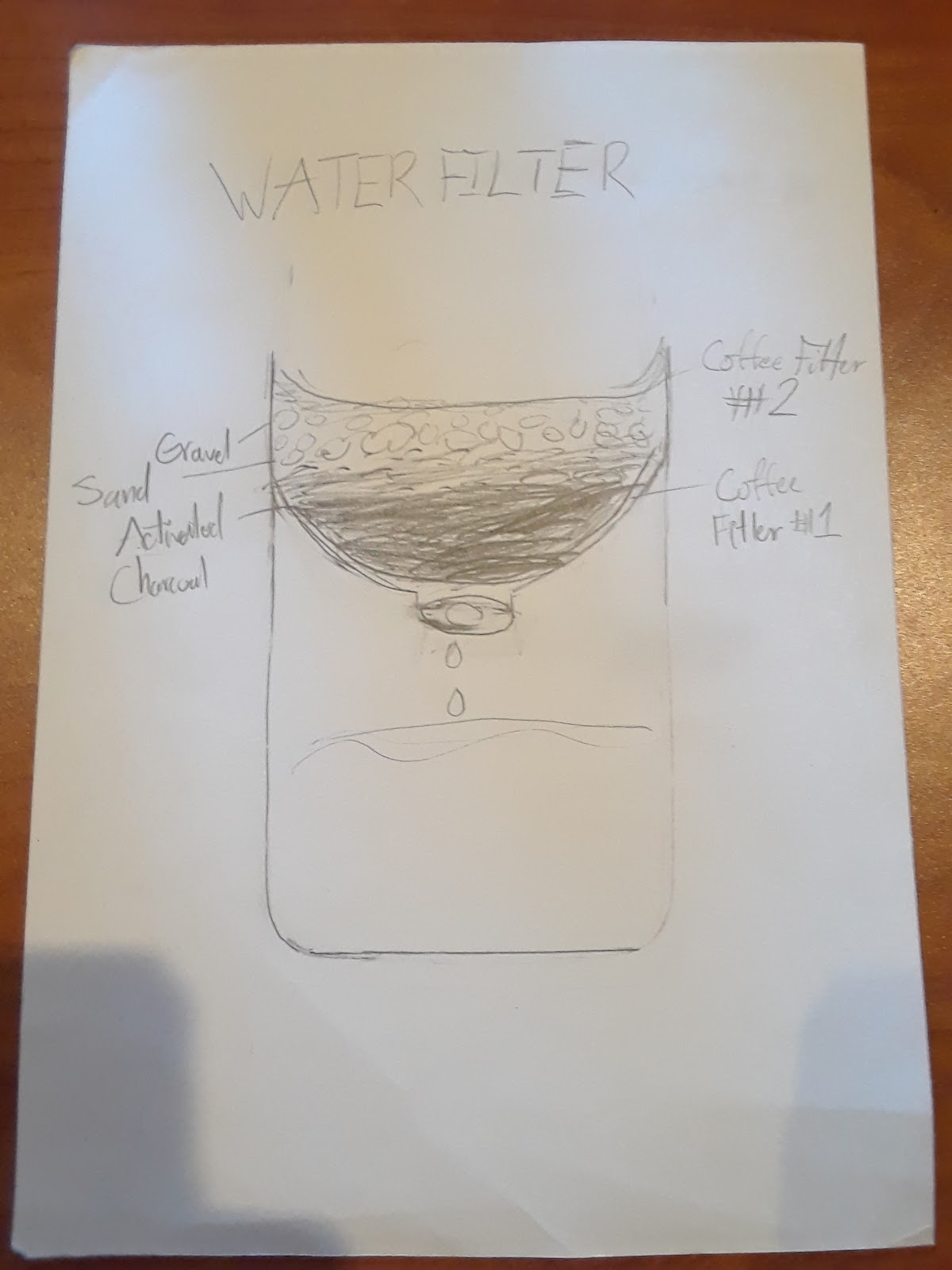
N.L (2018) Sketch of My Water Filter
N.L (2018) Construction Part 1 (Before)
N.L. (2018) Construction Part Two (Before)
N.L. (2018) Water Filter (After)
My guiding question for this experiment was Does the materials for a water filter affect the pH level of the filtered water? I tested my question by recording the pH levels of the water. I'm able to show how well my water filter works by using pictures of my water filter, before and after pictures of the water sample, and also by showing how the pH level of the filtered water changed.

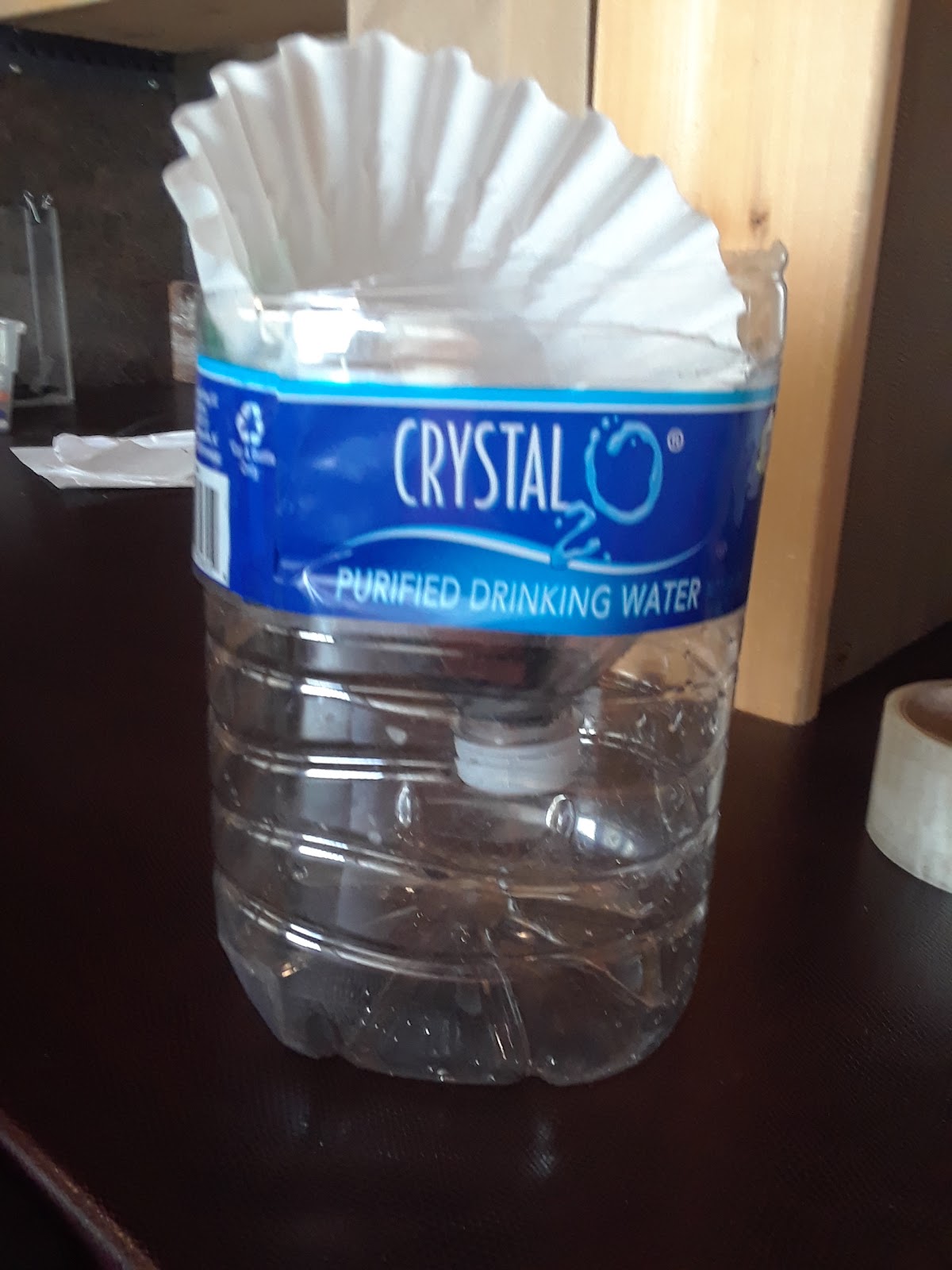
This was my first time making a water filter. I took my time constructing the water filter and my water filter remained stable throughout the experiment. My hypothesis was that my water filter will increase the unfiltered water's pH level because the water will go through a filtration process that filters the water so that it becomes safer to use. I used an activated charcoal water filter.  My water filter has a cap with a hole in it seal on the lid of the 1-gallon plastic bottle and the bottom of the bottle is used as a collector for the filtered water.

My water filter has a cap with a hole in it seal on the lid of the 1-gallon plastic bottle and the bottom of the bottle is used as a collector for the filtered water. My water filter relates to groundwater filtration because just like in groundwater filtration, my water filter has large and small gaps that filter large and small particles in water as the water travels throughout the filer. I layered the gaps in my water filter a specific way so that the large gap at the top and the small gap at the bottom take small and large particles out of the water. During the filtration process, gravity pulls the water through my water filter, which then allows water to pass through those gaps leaving particles behind.

I acquired most of the materials from the school. I did bring in a 1-gallon plastic bottle that I used at the base of my water filter.

Materials for My Water Filter:
  1. A 1-Gallon Plastic Bottle
  2. A Plastic Bottle Cap
  3. Two Coffee Filters
  4. Activated Charcoal 2 ½ cups
  5. Sand 2  cups
  6. Gravel 2 cups
  7. Water
  8. Digital pH meter
In order to build a stable water filter, I followed this step by step procedure:
  1. Wash all materials. (1-5)
  2. Cut the top of the 1-gallon plastic bottle. Cut at the top's midway point of the bottle.
  3. Add in all filtering materials, step by step, into the plastic bottle top. Flip the cut off top of the bottle and place the materials in from bottom to top in order.
  4. Place a coffee filter inside the top.
  5. Put 2 cups of activated carbon on top of the coffee filter.
  6. Place another coffee filter.
  7. Place sand and gravel on top of the coffee filter.
  8. Place another coffee filter on top of the sand and gravel.
My Water Filtration Process:
  1. Unfiltered water will pass through the 1st coffee filter
  2. Water will pass through a layer of activated charcoal
  3. Water will pass through a layer of gravel
  4. Water will pass through a layer of sand
  5. Water will pass through another layer of activated charcoal
  6. Water will  pass through the 2nd coffee filter
  7. Water will come through the hole in the plastic bottle cap
  8. The base of the 1-gallon plastic bottle will collect the filtered water.


Results:

         Before Filtration            After Filtration
pH             6.1                                7.3           
Color    dark and murky                no color       
Clarity cloudy                             clear           
Odor      harsh odor                       no odor        

Before 6.1
After 7.3 
Change 1.2
-log x =0.06
or
10^-2
x=  0.063095734448

BEFORE AND AFTER PICTURE

N.L. (2018) Before Filtration

N.L. (2018) After Filtration

This picture above represents where my water sample is on the pH scale before and after the filtration process. The pH scale ranges from 1-14 with 7 being neutral. Anything below 7 is acidic and anything above 7 is alkaline. 6.1 is below 7 so it's acidic. 7.3 is above 7 so it's alkaline.

In conclusion, my water filter successfully filtered the water from the Chicago River mixed with dirt into potable water. Through this test, I was able to prove that my data supports my hypothesis because the filtered water’s pH level did increase after going through the filtration process of my water filter.  My water filter kept its stability. My water filter collected a lot of large and small particles from the water. I learned about the different kinds of water filters there are and how I can make a water filter. If I do this experiment again another question I can think of is can I manipulate the pH level of water by using different types of water filters.

Works Cited
“The Different Types of Water Filters.” Five Different Types of Water Filters, 2018, www.softwaterfiltration.com/water-filters/.
“A Beginner's Guide to Charcoal Water Filters.” ALL ABOUT WATER FILTERS, 5 Sept. 2018, 

Friday, September 21, 2018

H20 and Us


This is my first action project for my first STEAM course on the unit “Water.” During this class, we have been working on converting measurements for liquids. We converted gallons into liters, liters into pints, and pints into cups, and we also converted gallons and liters into pounds. We went on a Field Experience to the Chicago River were we collected as much water as we could carry back to the school. We measured how much water each person had. We talked about our daily water usage and the categories that revolved around using water. I made a poster that shows my daily water usage, the US's water consumption per day compared to other countries, and I also included ways to reduce the amount of water we use.

I predicted that my daily water use would be around 55 gallons. After doing research and calculating the number of gallons I use, my daily water usage was 200 gallons. I use 120 gallons of water (60% of 200 gallons) for cleaning. I use 60 gallons (30% of 200 gallons) of water for hygiene. I use 15 gallons of water (7.5% of 200 gallons) for cooking. I use 5 gallons of water (2.5% of 200 gallons) for drinking. The average person in the United States uses 151 gallons per day which is 575 liters and 1,267 lbs. The average person in Japan uses 99 gallons of water per day which is 375 liters and 826 lbs. The average person in Mozambique uses 1.3 gallons of water per day which is 5 liters and 11 lbs. The average person in the US uses 51 more gallons than the average person in Japan. The average person in the US uses 150 more gallons than the average person in Mozambique. I think it’s crazy how much water we waste without even realizing it. On our Field Experience, it took me 18 minutes to carry the water I had. I carried about 5 gallons. I can’t imagine if I had to carry heavy amounts of water like 20 gallons every day. If I didn’t have a clean water source, I would have to walk 30 minutes to Montrose Beach (from my house). I would also have to carry about 10 gallons of water and make 20 trips back and forth in order to have 200 gallons of water for my daily use. Each trip would be 60 minutes. That would take me 1,200 minutes (20 hours). I calculated the time it would take me to carry my daily water usage from a nearby water source to my home by, multiplying the number of minutes each trip was by the number of trips I would have to take.

NL. (2018)  Help Save Water 

NL. (2018)  Help Save Water 

NL. (2018)  Help Save Water 

NL. (2018)  Help Save Water 

This action project has made me aware of how resources around the world are used and how we shouldn’t waste our resources. That concludes this action project. Remember that a little bit of water goes a long way.


Works Cited

“Human Development Reports.” Human Development Data (1990-2015) | Human Development Reports, English Home 

UNITED NATIONS DEVELOPMENT PROGRAMME, 2006, hdr.undp.org/en/content/human-development-report-2006.